Fomo token screener review: the stats it shows before you buy
A desk review of the Fomo token screener: the six stats it surfaces on every token page, the red and green flags FOMO Labs publishes, and the one number it does not.
Our verdict
The screener is the strongest part of Fomo. Six stats that actually matter — liquidity, holders, top-holder concentration, buy/sell ratio, market cap and 24h volume — sit on every token page, the filters put Verified ahead of Gainers, and charts carry other traders fills as overlays. FOMO Labs also publishes numbered thresholds for its own red flags, which is unusually specific for the category. What it is not is a regulated venue, and the trading fee percentage is never printed publicly, so cost cannot be compared before you install. A desk review of published material, not a funded live account.
Best for Traders who want memecoin screening data and a due-diligence checklist inside the same app they trade from, and who accept an unregulated, self-custody product.
FOMO Labs Inc. at a glance
- Provider
- FOMO Labs Inc.
- Operator
- FOMO Labs Inc.
- Custody
- Non-custodial wallets, powered by Privy
- Order routing
- DFlow, with MEV protection
- Sign-in
- Email code or Apple ID, no seed phrase
CFDs are complex instruments and carry a high risk of losing money rapidly due to leverage. Most retail accounts lose money.

How this review was done. Every other review on Pipwarden comes from an account we opened, funded and withdrew from. This one does not, and it would be dishonest to imply otherwise. Fomo is a self-custody crypto app, not a regulated broker with a licence to check or a statement to download, so what follows is a desk review of what FOMO Labs Inc. publishes about its own product, with every claim attributed. Where the company states something we could not verify independently, we say so.
With that said, there is a reason to write it up. The Fomo token screener is the part of the app a trader coming from forex will recognise immediately, and it is better documented than most of what sits beside it in the memecoin category.

What the Fomo token screener puts on one page
A forex trader is used to a broker showing spread, swap and margin in one window. The memecoin equivalent is a different set of numbers, and on most platforms they are scattered across a block explorer, a chart site and a chat group. Fomo’s claim is that it collapses all of that into the token page.
In the company’s own words, from its answers library: “fomo puts all of these stats in one place on every token page. You can see available liquidity, buy and sell volume, buyer-versus-seller ratios, number of holders, top holder concentration percentages, and detailed holder information. Price charts are available in both candlestick and line formats, and you can see other traders’ buy and sell actions overlaid directly on the chart for additional context.”
That last detail has no obvious forex analogue. Seeing other participants’ entries and exits plotted on the chart you are already reading is not something a retail FX platform offers, and on a token with a few hundred holders it is genuinely informative. You can browse the token pages on fomo.family from a browser without installing anything.
The four filters that do the first cut
On the web platform the token list can be filtered four ways: Verified, Trending, Most held and Gainers. Each row then carries price, market cap, 24-hour change, volume, liquidity and holders.
The ordering of those filters is a design decision worth noticing. Putting Verified first, before Trending and Gainers, is the opposite of what an engagement-maximising app would do. A trader arriving with no idea what to buy is shown the vetted list before the one sorted by whatever has pumped hardest in the last hour. It is a small thing, but it is the kind of small thing that separates a tool from a casino.
The stats Fomo tells you to read, and why each one matters
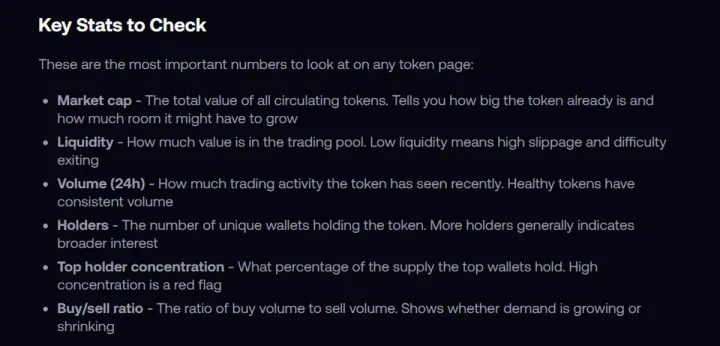
The company publishes its own guide to reading token stats, and the list is the right one. For anyone coming from FX, the mapping is not hard:
Market cap — the total value of all circulating tokens. The closest FX analogue is the size of the instrument you are trading: it tells you how much room is left, and how much your own order will move it.
Liquidity — how much value sits in the trading pool. Fomo puts it plainly: “Low liquidity means high slippage and difficulty exiting”. This is the single number that decides whether you can get out.
Volume (24h) — recent trading activity. “Healthy tokens have consistent volume”, which is a useful phrasing, because a single spike is the thing to be suspicious of.
Holders — the number of unique wallets. More holders generally means broader interest rather than a handful of insiders.
Top holder concentration — what share of supply the largest wallets control. Fomo calls high concentration “a red flag” outright.
Buy/sell ratio — the balance of buy volume against sell volume, which shows whether demand is growing or shrinking.
The red flags Fomo names, with numbers attached
Plenty of apps tell you to “do your own research” and stop there. Fomo publishes the thresholds, which is more useful and more exposed. Its red-flag list reads:
Top holder owns 20%+ — “A single wallet holding a large percentage of supply can dump the price at any time”.
No liquidity lock — “If the liquidity isn’t locked or burned, the creator could pull the pool”.
Volume but no holders — high volume against very few wallets, which the company says “might indicate wash trading or bot activity”.
Sell volume dominates — if sellers consistently outpace buyers, the trend is likely downward.
Sudden liquidity drops — liquidity being removed is “an early warning sign of a rug”.
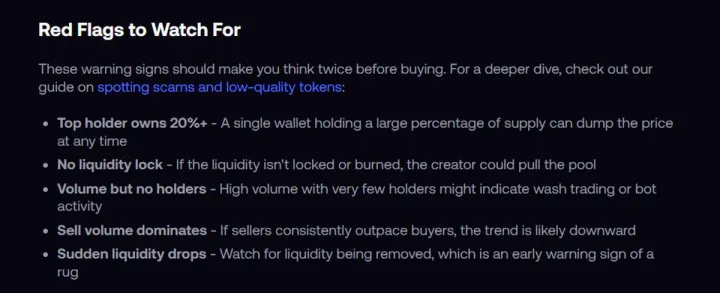
Naming 20% as the line is the kind of specificity a marketing team usually talks a product out of. It gives a beginner something to act on, and it gives anyone else a stick to measure the app by.
And the green flags
The mirror list is shorter and just as concrete: growing holder count, a balanced buy/sell ratio rather than one tilted heavily toward buys, locked or burned liquidity, consistent volume across days rather than a single spike, and distributed holdings with no single wallet dominating supply.
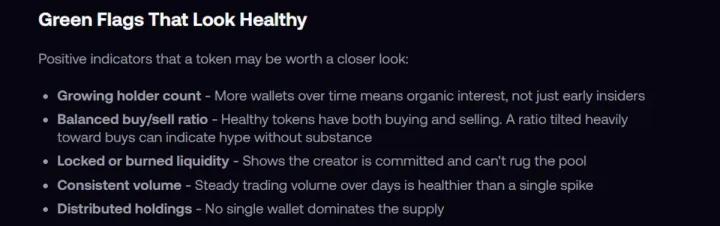
Note the second one. “A ratio tilted heavily toward buys can indicate hype without substance” is a counter-intuitive thing for a trading app to print, because heavy buying is exactly the moment it would most like you to press the button.
The checklist to run before you buy
A separate answers page turns the same material into a five-point checklist, and it opens with a sentence most of the category will not write: “No memecoin is completely "safe" — they’re all speculative by nature.” The stated goal is not a risk-free trade but to “filter out the obvious scams and low-quality tokens”.
Liquidity status — locked or burned, or could the creator drain the pool.
Holder distribution — a single wallet holding 15%+, excluding burn and dead addresses, is flagged as a warning.
Volume — consistent activity across hours suggests organic interest.
Contract verification — “Unverified contracts may contain hidden functions”.
Token age — tokens that have traded for more than 24 to 48 hours have “at least passed the initial scam window”.
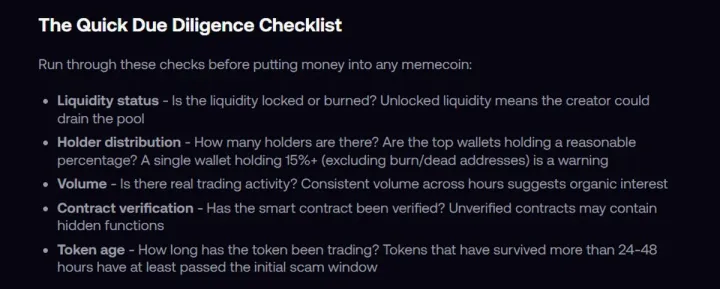
Every item on that list maps to a field on the token page, which is the point. The screener is not just a data display; it is built to be read against a checklist the company also supplies. You can work through it on a live token page and see how far the two line up.
The library behind the screener
The stats guide is one of 73 articles in the answers section, and the surrounding ones are the right surrounding ones: what liquidity is, what locked liquidity means, what market cap and trading volume are, what slippage is, how to spot a rug pull, position sizing, risk-to-reward, and when to sell. For a forex trader this is familiar territory in unfamiliar clothes — the concepts are the ones you already use, applied to an asset class where the failure modes are different.
It is also, plainly, a content marketing asset. That does not make it wrong. The explanations are accurate and the risk sections are not softened, which is more than can be said for a lot of broker education.
What sits underneath the screener
For completeness, because a screener is only as useful as the account behind it. Fomo states that wallets are non-custodial and “powered by Privy”, that order routing goes through DFlow “for secure, fair order routing” with MEV protection, and that sign-in is by email code or Apple ID with “no seed phrases”. Trading is multichain and gasless, funding works through Apple Pay with $25, $50, $100 and $250 presets, and the first buy carries a $0 fee. The company reports 2,500,000 traders.
Naming Privy and DFlow specifically is more disclosure than most apps in this category offer. We have not audited either integration and are reporting what the vendor states; the current descriptions are on the fomo.family site.
What Fomo does not publish
One gap is worth stating plainly, because it is the number a Pipwarden reader would ask for first. Fomo describes its pricing as “a straightforward percentage on trades” with “gas included” and “no hidden spreads”, but nowhere on the public site does it print what that percentage is. The only hard figure is the $0 fee on the first buy.
In practice that means you cannot compare Fomo on cost before installing it, which is exactly the comparison this site exists to make for brokers. It is not a reason to avoid the app; it is a reason to check the fee on your own first small trade before sizing up.
Risk warning
Fomo is not a licensed broker or a regulated exchange. There is no FCA, ASIC or CySEC entry to look up, no segregated client money, no deposit insurance and no compensation scheme. If something goes wrong there is no regulator to complain to.
The assets themselves are the most speculative in retail finance. Memecoins and newly launched tokens can and regularly do go to zero, and no amount of screening changes that — Fomo says so itself. Self-custody means the wallet is yours, and so is every consequence of losing access to it. Treat any position as capital you can write off entirely, not as a trade with a stop that will save you.
The short version
Judged as what it is — a screening and research layer on a self-custody memecoin app — the Fomo token screener is the strongest part of the product. The six stats it surfaces are the right six, the filters put Verified ahead of Gainers, the charts carry other traders’ fills as overlays, and the company publishes numbered thresholds for its own red flags rather than hiding behind a generic risk disclaimer.
What it is not is a regulated venue, and the missing trading fee percentage means the one comparison this site normally runs cannot be run from the outside. If you are a forex trader curious about the asset class, the honest advice is to look at the screener and the answers library first, use the checklist on a token you have no intention of buying, and only then decide whether any of it is for you.
What we liked
- Every stat that matters for a memecoin sits on the token page: liquidity, 24h volume, holders, top-holder concentration and buy/sell ratio, instead of being spread across an explorer and a chart site
- FOMO Labs publishes numbered thresholds for its own red flags — a top holder above 20 percent, a single wallet above 15 percent excluding burn addresses — rather than a generic risk disclaimer
- Token list filters lead with Verified rather than Trending or Gainers, which is the opposite of an engagement-first default
- Charts are available as candlestick or line with other traders buy and sell actions overlaid, context a standalone screener cannot provide
Specifications
- Operator
- FOMO Labs Inc.
- Regulation
- None — not a licensed broker or exchange
- Custody
- Non-custodial wallets, powered by Privy
- Order routing
- DFlow, with MEV protection
- Sign-in
- Email code or Apple ID, no seed phrase
- Platforms
- iOS, Android and web
- Funding
- Apple Pay, presets $25 / $50 / $100 / $250
- First buy fee
- $0 (company claim)
- Trading fee
- "A straightforward percentage on trades" — figure not published
- Token stats shown
- Liquidity, buy and sell volume, buy/sell ratio, holders, top-holder concentration
- Charts
- Candlestick and line, with other traders fills overlaid
- Learning library
- 73 articles in the answers section
- Reported users
- 2,500,000 traders (company claim)
Figures as published by FOMO Labs Inc. at fomo.family. They vary by account type, entity and region.
This review describes what we saw on our own accounts. It is not personal financial advice.